Classics
The City of God
St. Augustine of Hippo
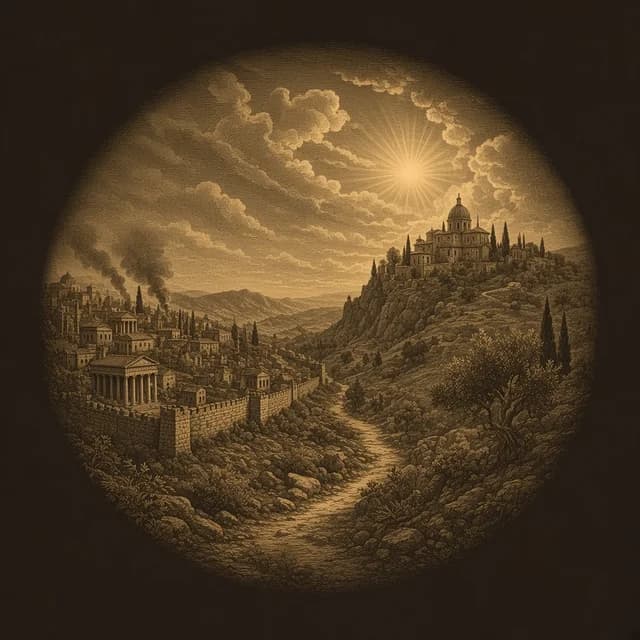
Augustine defends Christianity after the sack of Rome by tracing two cities through history: one ordered by self-love, the other by the love of God. The work examines empire, worship, and the hope of eternal peace.
Dods translation
Translated by Marcus Dods
English of 1871; NPNF reprint.
Public domain. Modern study editions such as Dyson and Bettenson remain copyrighted.
About this book
The City of God is Augustine's long defense of Christianity after the sack of Rome in 410. Pagans blamed the new religion for the city's humiliation; Augustine answers by retelling Roman history, examining the old gods, and then tracing two societies through Scripture: the earthly city, ordered by self-love, and the city of God, ordered by the love of God. The twenty-two books move from controversy and Roman religion toward creation, the two cities' histories, and the last things. Scripture, philosophy, and civic memory stay in conversation rather than being separated into independent treatises.
The work shaped later Christian thinking about history, politics, and the hope of the resurrection. It is not a brief essay on church and state; its force comes from the patience with which Augustine tests claims about happiness, fate, demons, and empire against the biblical story. Readers often begin with the opening books' reply to Rome's critics, then find the later books' account of the two cities more constructive. Keep the whole arc in view: the early dismantling of pagan theology prepares the later claim that true peace is not secured by the gods of the earthly city. The chapter arguments in this English edition are a useful map through a very large book.
Contents
Choose a section to begin reading.
- City of God